
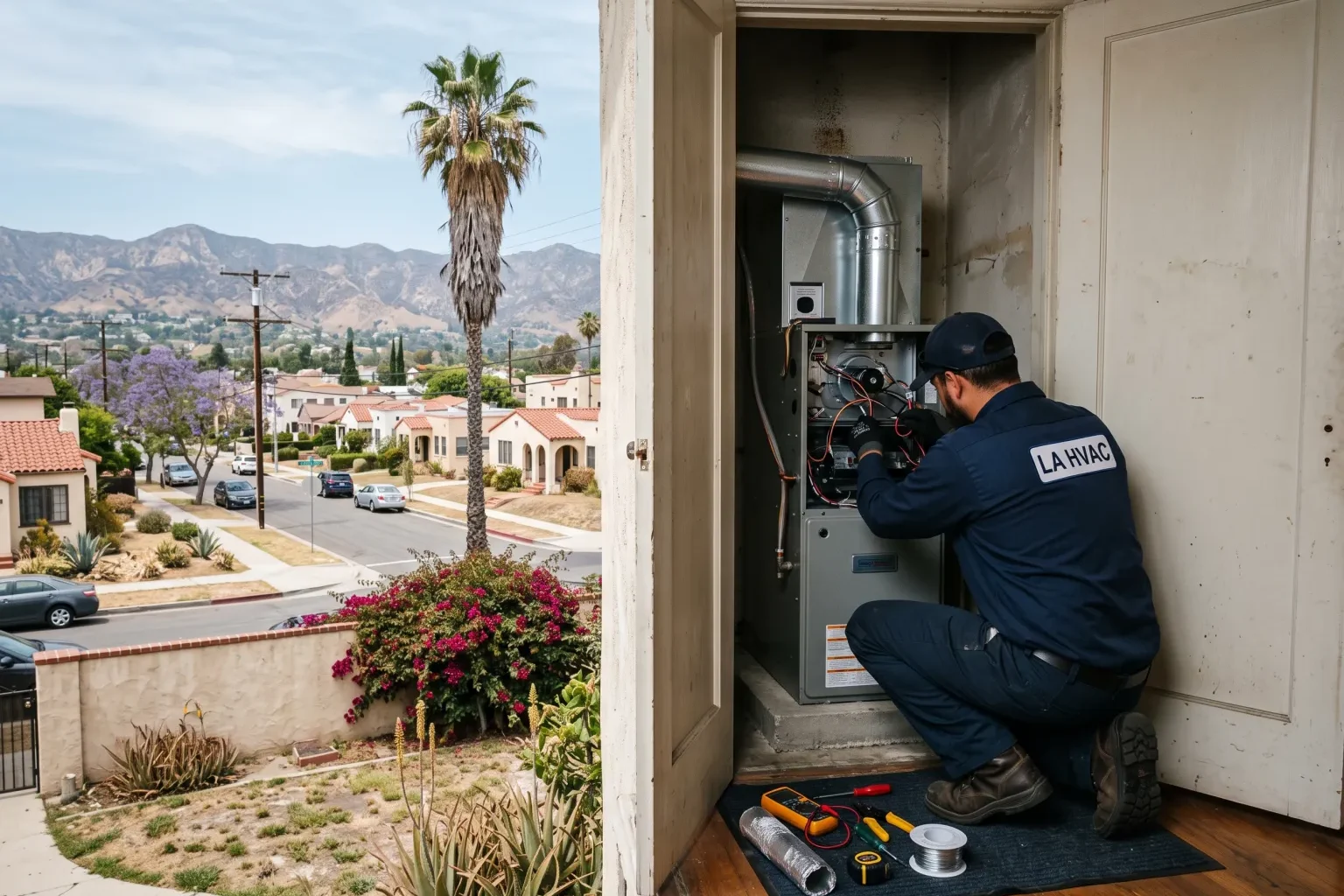
The short answer
Replace a furnace when repairs keep returning, the heat exchanger is damaged, or the unit can no longer heat the house evenly. We inspect the venting, gas supply, ducts, and electrical before recommending equipment, and we explain how local NOx rules affect your choices.
Southern California winters are short, so a gas furnace in Pasadena can sit idle for months and then get asked to run on a cold January night. That stop-and-start pattern is why many furnaces in the foothill cities quietly age in the attic or hall closet until something finally gives. SummitAir HVAC Contractors replaces and installs furnaces for homeowners in Pasadena, Altadena, South Pasadena, San Marino, and the surrounding communities. A new furnace is a bigger decision than it used to be, because regional air rules now shape which gas equipment can be sold and installed, and because many households are weighing a heat pump against another gas unit. Below we cover the warning signs that point toward replacement, what we inspect before writing a proposal, how we help you decide between repairing and replacing, the factors that move the cost up or down, and the step-by-step flow of an installation day.
When a Furnace Is Ready to Be Replaced
Age alone does not decide it. A well-kept furnace can keep going for a long time, and a neglected one can wear out early. What matters is how the unit behaves and what a technician finds inside it. These are the patterns that usually lead to a replacement conversation:
- Repeated service calls for ignition, flame sensor, or blower problems in the same season
- A cracked or corroded heat exchanger found during an inspection
- Rooms that never warm up, even with the thermostat turned well above normal
- Rust, soot, or scorch marks around the burner compartment or vent connector
- A yellow, flickering burner flame instead of a steady blue one
- Loud booms at startup, rattling panels, or a blower that squeals
- Parts that are discontinued or difficult to source for an older model
What We Inspect Before Recommending a Furnace
Swapping a furnace box for box can repeat old mistakes. Our technicians look at the whole heating path so the new equipment fits the house it is going into.
We start with the heating load. Older stucco homes around Pasadena often have aging ductwork in hot attics, single-pane windows, and additions built at different times, so the right size may differ from what is installed now. We then check the venting: its material, slope, clearances, and whether it suits the efficiency level you are considering. A high-efficiency condensing furnace needs a drain and a different vent design than a standard model.
Next comes the gas line, shutoff, and sediment trap, followed by the electrical supply and thermostat wiring. Finally we inspect the ducts and return air. Leaky or undersized ducts can undercut any new furnace, so we point out sections that need sealing, repair, or replacement before or during the install.
Repair, Replace, or Switch to a Heat Pump
If the furnace has a simple failure such as a bad igniter, a worn inducer motor, or a faulty pressure switch, a repair is often the reasonable choice. We tell you plainly when that is the case.
When replacement is on the table, there is a regional factor to keep in mind. South Coast AQMD Rule 1111 limits NOx emissions from natural-gas fan-type central furnaces sold and installed in the Los Angeles region, and the district has been amending it toward zero-emission requirements. Because the district sets and revises the compliance dates, anyone planning a furnace replacement should check the current rule. We review where things stand at the time of your project and explain what it means for the equipment you can choose.
For some homes, a heat pump that both heats and cools is worth comparing side by side with a new gas furnace. Rebates on heat pumps depend on your utility. LADWP residential electric customers may qualify for Consumer Rebate Program rebates on qualifying systems, while many homes outside the City of Los Angeles are served by Southern California Edison, and offers differ. Note that the federal 25C credit covered qualifying heat pumps placed in service before December 31, 2025 and is not available for new installations after that date. We confirm any current offer before quoting it.
Factors That Shape Installation Cost
Every furnace quote reflects the house as much as the equipment. The biggest drivers include the following:
- Furnace type, efficiency level, and whether it is single-stage, two-stage, or modulating
- Installation location, such as an attic, garage, closet, or crawlspace, and how easy it is to reach
- Venting changes needed for the new unit
- Duct repairs, new returns, or a replacement plenum
- Gas line or electrical updates
- Pairing the furnace with a new coil or cooling system
- City permit and inspection requirements
What Happens on Installation Day
After you approve the proposal, we schedule the work and handle the permit where one is required. On the day, the crew lays down floor protection along the path to the equipment, shuts off gas and power, and removes the old furnace.
The new unit is set, leveled, and connected to the gas line, venting, ducts, and electrical. We test for gas leaks, verify the flame and burner operation, measure temperature rise and static pressure, and confirm the safety controls trip as they should. The thermostat is set up and tested through a full heating cycle.
We finish by walking you through filter size and replacement timing, showing where the shutoffs are, and explaining what normal startup sounds are. If an inspection by the city is part of the permit, we coordinate that step with you.