
The short answer
If your AC blows warm air, runs nonstop, leaks water, trips breakers or makes new noises, schedule a repair before a small failure damages the compressor. We test the electrical, refrigerant, airflow and drainage sides of the system, then explain the fix and its alternatives.
Most air conditioners do not quit all at once. They give warnings first: a longer run time on hot afternoons, a faint buzz from the side yard, a bedroom that never quite cools down. SummitAir HVAC Contractors repairs central air systems, heat pumps and ductless units for homeowners in Pasadena, Altadena, South Pasadena, San Marino, Arcadia, Glendale and neighboring communities. This page covers the warning signs worth acting on, what our technicians test, how to think about fixing versus replacing, what drives the cost of a repair, and how a typical service call unfolds from the first conversation to the final temperature check.
Symptoms that mean your air conditioner needs attention
Pasadena summers are dry and long, and inland heat makes a weak system obvious quickly. The sooner a problem is caught, the more likely it is a modest part rather than a major component. Shut the system off and call if you notice any of these:
- Air from the supply registers feels cool but not cold, or barely moves
- The outdoor fan spins but the compressor stays silent, or the unit hums without starting
- Ice forms on the refrigerant lines or the indoor coil
- Water pools near the furnace closet, drips from an attic ceiling, or the drain pan overflows
- The breaker trips repeatedly, or the system short-cycles on and off every few minutes
- Grinding, squealing, rattling or clicking that was not there last season
- A burning or musty smell when the blower starts
- Rooms at opposite ends of the house sit several degrees apart
What our technician tests on a repair call
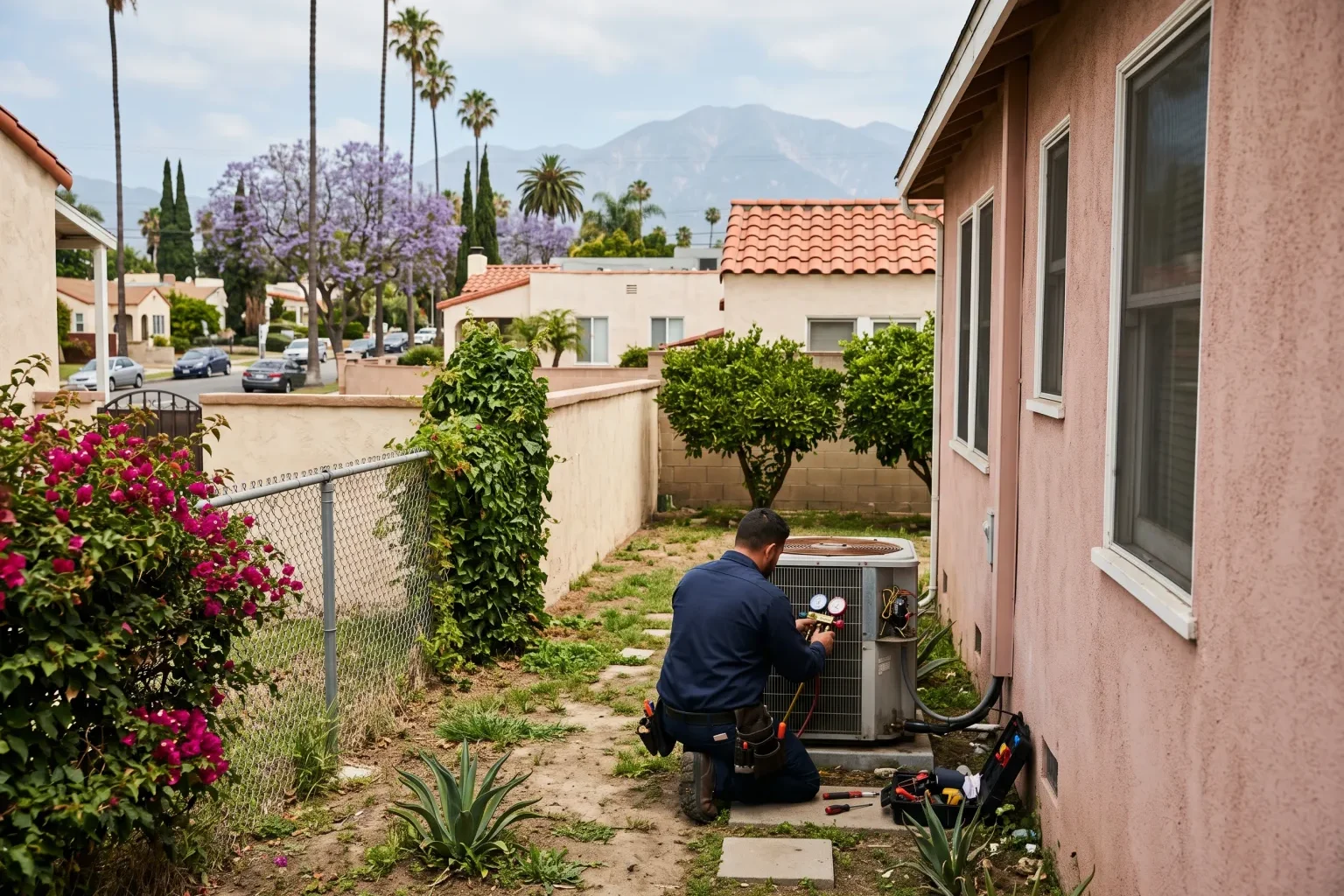
Guessing is costly, so the visit starts with measurements. At the outdoor unit, the technician checks incoming voltage, the run capacitor's rating against its actual reading, the contactor's contact surfaces and the condition of the fan motor. Refrigerant pressures and line temperatures are recorded to calculate superheat and subcooling, which reveal whether the charge is low, overcharged or restricted. A coil caked with dust from a Santa Ana wind event shows up here as well.
Inside, attention turns to airflow. A clogged filter, a matted evaporator coil, a weak blower motor or a collapsed attic duct can all mimic a refrigerant problem. The condensate trap and drain line get flushed or inspected, the float switch is tested, and the thermostat wiring and settings are verified. Only when the readings line up does the technician name the cause and propose a fix.
If a refrigerant leak is suspected, we explain how we would locate it and whether repairing it is practical for your equipment's age and refrigerant type, rather than simply topping off the charge and sending you on your way.
Fix it or replace it: how to weigh the choice
Plenty of repairs are clear wins: a failed capacitor, a pitted contactor, a clogged drain, a loose wire or a worn fan motor. These parts are inexpensive relative to the system and restore normal operation on a sound unit. We recommend them without hesitation.
The decision gets harder when the compressor fails, the outdoor coil develops multiple leaks, or the system uses an older refrigerant that is costly to service. Age matters, but so do the condition of the indoor coil, how well the ducts perform, and how comfortable the house has been. If the unit has been struggling for several summers, a repair may only buy one more season.
When replacement deserves a look, we lay out options side by side, including heat pumps, which handle both cooling and heating. LADWP residential customers can apply for rebates on qualifying heat pump systems after installation, while many homes outside the City of Los Angeles are served by Southern California Edison, so we confirm what applies to your address. The federal 25C tax credit is no longer available for new installations after 2025.
What drives the cost of an AC repair
Every repair is quoted after diagnosis, and several factors shape that number:
- The specific part that failed and whether it is a common item or brand-specific
- Refrigerant type and how much is needed once a leak is repaired
- Access to the equipment, such as a tight attic, a rooftop unit or a crowded side yard
- Whether related damage, like a burned wire or rusted drain pan, needs attention at the same time
- Timing, since a call during a heat wave may involve scheduling around high demand
How a repair visit works from start to finish
It begins with a short conversation. Tell us what the system is doing, when it started and what kind of equipment you have, and we schedule a technician. On arrival, they listen to your description, look at the thermostat, then inspect and test both the indoor and outdoor sections.
Once the cause is confirmed, you get a plain explanation and a written quote before any work begins. If you approve, the repair is completed, the system is restarted and the technician measures supply and return temperatures to confirm it is cooling properly. Before leaving, they mention anything else worth watching, such as a filter that needs changing more often during wildfire smoke or a duct that is losing air into the attic.